
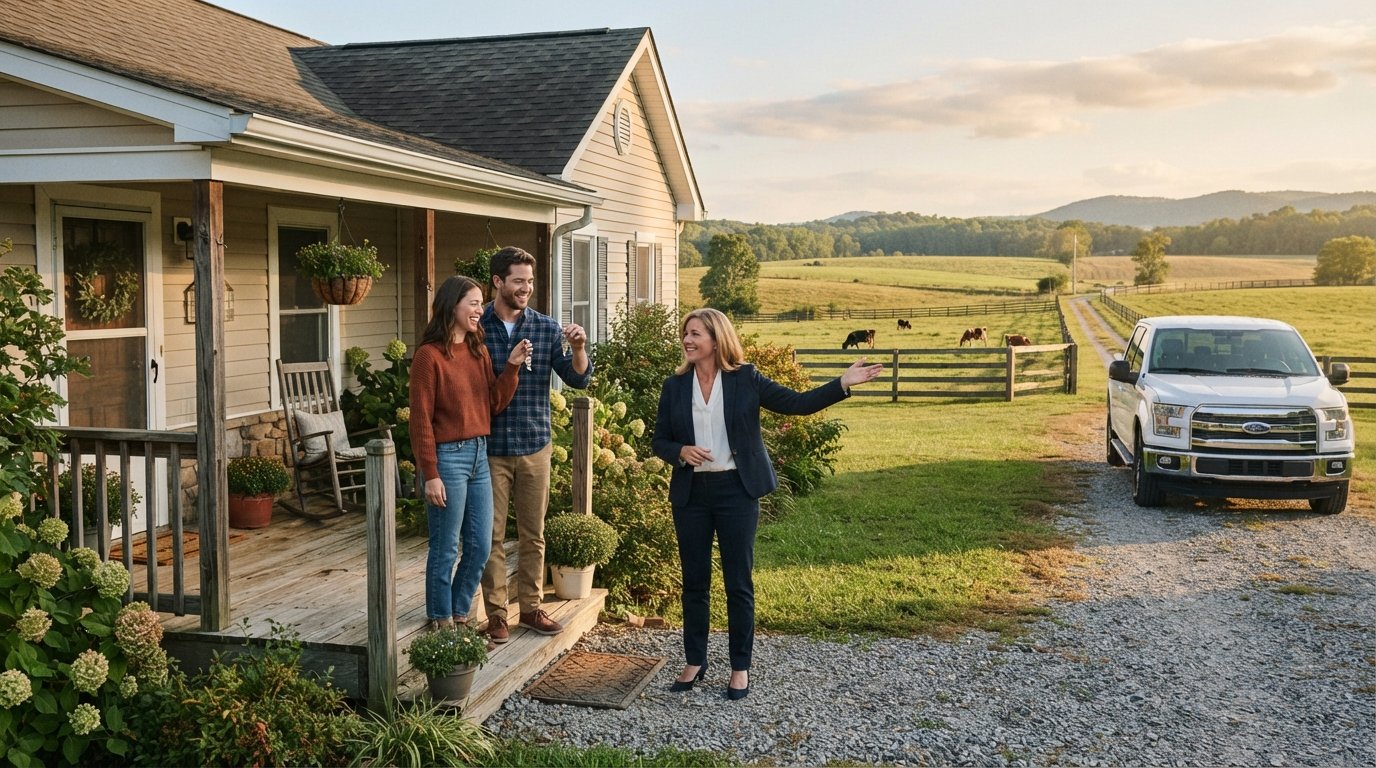
USDA Loan Eligibility and Benefits 2026: A Complete Guide
USDA loan eligibility and benefits 2026 include zero down payment and flexible credit, helping rural buyers own a home with minimal upfront cash.

By Author 1
For millions of Americans living outside major metropolitan areas, the dream of homeownership often feels out of reach as home prices and interest rates climb. But there is a powerful government-backed option that many buyers overlook: the USDA loan. Backed by the U.S. Department of Agriculture, this program was designed to make rural and suburban homeownership affordable, and in 2026 it remains one of the most generous mortgage products on the market. If you have ever assumed that a zero-down mortgage with below-market rates sounds too good to be true, the USDA program is here to prove otherwise. Understanding USDA loan eligibility and benefits in 2026 can put you in a position to buy a home with far less cash upfront than you ever imagined.
This guide breaks down who qualifies, how the program works, what it costs, and why it deserves a serious look this year. Whether you are a first-time buyer, a repeat buyer, or a homeowner weighing a refinance, the details below will help you decide if a USDA loan fits your financial picture. For a broader view of how this program stacks up against other financing options, you can also explore the resources at LoanFinancing, which offers educational tools for comparing personal loan and mortgage products.
What Is a USDA Loan and Who Is It For?
The USDA loan, technically called the Single Family Housing Guaranteed Loan Program, is a mortgage backed by the U.S. Department of Agriculture. The agency does not lend money directly in most cases. Instead, it guarantees a portion of the loan made by an approved private lender, which reduces the risk to that lender and allows it to offer more favorable terms to borrowers. That guarantee is the engine behind the program's signature benefits: no down payment requirement, competitive interest rates, and flexible credit standards compared to many conventional loans.
This program exists to support housing in rural and suburban communities. The USDA defines eligible areas as those with populations typically under 35,000, though the exact boundaries are updated regularly and can include pockets just outside fast-growing metro areas. Many buyers are surprised to learn that they do not need to be farmers, and the property does not need to sit on acres of farmland. A modest home in a small town or an outlying suburb can qualify just as easily as a property surrounded by fields.
The program is especially valuable for first-time buyers, but repeat buyers are not excluded. Unlike some government programs, there is no strict first-time buyer requirement. The main limitation is that you can only have one USDA loan at a time, and the property must be your primary residence. That makes it a strong fit for families putting down roots in a rural community, veterans returning to small-town life, and young professionals who want more space for their money outside expensive city centers.
USDA Loan Eligibility Requirements in 2026
Eligibility for a USDA loan rests on three broad pillars: the borrower, the property, and the household income. Failing any one of these can disqualify an otherwise strong application, so it pays to review all three before you start house hunting. The rules are more flexible than many people assume, but they are also specific, and the income limits in particular are tied to your location and family size.
On the borrower side, the USDA looks for a stable credit history rather than a perfect score. Most approved lenders want to see a middle credit score of at least 640, though some lenders work with scores as low as 620 when other compensating factors are strong. You will also need proof of steady income, typically two years of employment history, and a debt-to-income ratio that generally stays at or below 41 percent of your gross monthly income. That ratio measures how much of your monthly pay goes toward housing plus other debts like car loans, student loans, and credit cards.
The property must be located in an eligible rural area according to the USDA's official map, and it must serve as your primary residence. You cannot use a USDA loan for an investment property or a vacation home. The home also has to meet basic safety and livability standards, which the appraisal will confirm. Here is a quick summary of the core borrower requirements:
- U.S. citizenship or eligible non-citizen status with valid documentation
- Middle credit score of 640 or higher for most lenders (some allow 620 with compensating factors)
- Debt-to-income ratio at or below 41 percent, including the new mortgage payment
- Stable and documented income for at least two years
- No outstanding federal debt delinquencies, such as defaulted student loans
Income limits are the piece that trips up the most applicants. The USDA caps total household income at 115 percent of the median income for the area, adjusted for household size. The key word is household: the income of every adult living in the home counts, even if they are not on the loan. In 2026, these limits vary widely by county. In some rural counties, a family of four might qualify with income up to roughly $110,000, while higher-cost eligible areas can push that ceiling considerably higher. Because the numbers change annually and differ by location, it is smart to verify your specific county's limit before applying.
How to Check If Your Area and Income Qualify
The fastest way to confirm eligibility is to use the USDA's online eligibility tool, which maps eligible areas by address and lists current income limits by county and household size. If you are working with a lender, they can run the same check in minutes. Do not assume you are disqualified because you live near a city; the eligible boundaries often stretch further than buyers expect. Conversely, if you are right on the edge of an income limit, a small change in household size can shift the outcome, so verify with current 2026 figures rather than older data.
The Biggest USDA Loan Benefits in 2026
The headline benefit of a USDA loan is the zero down payment requirement. For buyers who have struggled to save a large down payment while rents rise, this single feature can turn a distant goal into an immediate possibility. Most mortgage programs require at least 3 to 5 percent down, and conventional loans often demand 20 percent to avoid private mortgage insurance. A USDA loan removes that barrier entirely, which means your savings can go toward closing costs, moving expenses, or an emergency fund instead of a down payment.
Beyond the down payment, USDA loans offer interest rates that are typically lower than conventional mortgages and comparable to other government-backed options. Over the life of a 30-year loan, even a small rate advantage can save tens of thousands of dollars. The program also allows the seller to contribute toward closing costs, and in some cases, the buyer can finance the upfront guarantee fee into the loan rather than paying it in cash at closing. That combination keeps the out-of-pocket cost of buying remarkably low.
Credit flexibility is another major advantage. Borrowers with limited credit history or a few past blemishes can still qualify if they demonstrate responsible financial behavior. The USDA also permits co-borrowers who are not spouses, which helps multigenerational households pool income. Finally, the program offers a streamlined refinance option for existing USDA borrowers, making it easier to lower a rate or reduce a payment without a full underwriting ordeal. Here is how the benefits stack up in a quick comparison:
- No down payment required, preserving your cash reserves
- Competitive, below-market interest rates backed by a federal guarantee
- Flexible credit standards, with scores starting around 620 to 640
- Seller concessions allowed, which can cover much of your closing costs
- Streamlined refinance available for current USDA borrowers
These benefits add up to a program that can make homeownership possible for buyers who would otherwise be priced out. When you compare the total cost of a USDA loan against a conventional loan with a 5 percent down payment and private mortgage insurance, the USDA option often wins on monthly payment and upfront cash alike.
Costs, Fees, and the Fine Print
No mortgage is completely free of costs, and the USDA loan is no exception. The program charges two fees that every borrower should understand. The first is an upfront guarantee fee, which is currently 1 percent of the loan amount. This fee can be paid at closing or rolled into the loan balance, which is the choice most buyers make. The second is an annual fee, currently 0.35 percent of the loan balance, divided into monthly payments. This annual fee is similar in spirit to mortgage insurance, but it is generally cheaper than the private mortgage insurance that conventional buyers pay when they put less than 20 percent down.
Closing costs are separate from these fees and typically run 2 to 4 percent of the purchase price. The good news is that USDA rules allow sellers to pay up to 6 percent of the purchase price toward the buyer's closing costs, and lenders can also offer credits. Some buyers negotiate a slightly higher purchase price in exchange for seller-paid costs, which keeps their cash outlay minimal. Because the upfront fee can be financed, many USDA buyers close with very little money out of pocket beyond the appraisal and a few third-party expenses.
It is worth noting that the annual fee stays in place for the life of the loan, unlike private mortgage insurance, which can be canceled once you reach 20 percent equity. Even so, the combination of a lower rate and zero down payment usually outweighs that long-term cost, especially for buyers who plan to stay in the home for several years. Run the numbers for your own situation, and compare the total monthly payment against alternatives before deciding.
How to Apply: A Step-by-Step Roadmap
Applying for a USDA loan follows a logical sequence, and knowing the steps in advance can save you time and stress. The process starts long before you tour a home. Begin by checking your credit report for errors, saving what you can for closing costs, and gathering documents like pay stubs, tax returns, and bank statements. Then confirm that your target area is USDA-eligible and that your household income falls under the county limit.
From there, the process moves through underwriting and closing. Here is a practical roadmap to follow:
- Verify eligibility for the property area and your household income using current USDA tools.
- Get preapproved with a USDA-approved lender so you know your budget and can shop with confidence.
- House hunt within eligible areas and make an offer once you find the right home.
- Complete the appraisal and underwriting, submitting any additional documents your lender requests.
- Close on the loan, paying only the remaining closing costs and any fees not financed.
Preapproval is the step where many buyers gain a real advantage. Sellers take USDA offers more seriously when they see a preapproval letter, and you avoid falling in love with a home you cannot finance. The underwriting stage for USDA loans can take slightly longer than conventional loans because of the extra federal review, so build a few extra weeks into your timeline. Patience during this phase is normal and rarely a sign of trouble.
Once you close, the ongoing responsibilities are simple: make your payments on time, keep the home as your primary residence, and maintain the property. If you later want to refinance, the USDA streamlined option can help you capture a lower rate with minimal paperwork.
USDA Loans vs. Other Government Programs
It helps to see the USDA loan in context. The FHA loan, backed by the Federal Housing Administration, also offers low down payments, but it requires 3.5 percent down and carries both upfront and annual mortgage insurance premiums that are often higher than USDA fees. FHA loans have no income limits and no rural area restriction, so they remain a strong choice for urban buyers. VA loans, available to veterans and service members, offer zero down payment and no monthly mortgage insurance, making them arguably the best deal of all for those who qualify. USDA loans sit between the two: more geographically restricted than FHA, but cheaper for rural buyers than FHA, and available to a broader population than VA.
Conventional loans, by contrast, are not government-backed, and they typically require higher credit scores and larger down payments. Their advantage is flexibility: you can buy any property, in any location, for any purpose. If you are set on a rural or small-town home and your income fits the limits, the USDA program usually delivers the lowest upfront cost and the most forgiving credit standards. If you are unsure which path fits, comparing quotes side by side is the surest way to see the difference in real numbers.
Common Mistakes That Sink USDA Applications
Even qualified buyers sometimes stumble. The most frequent mistake is forgetting that total household income counts. A buyer who qualifies on their own income may be pushed over the limit when a partner's or relative's income is included, so review all household earnings before applying. Another common error is assuming an area is ineligible without checking; the eligible map changes, and many suburbs that feel urban are actually approved.
Credit missteps also derail applications. Opening a new credit card or financing a car during the mortgage process can change your debt-to-income ratio and raise red flags with underwriters. Keep your financial profile stable from preapproval through closing. Finally, some buyers skip preapproval and make an offer first, only to discover their income or the property does not qualify. Doing the eligibility homework upfront prevents wasted effort and disappointment.
Final Thoughts on USDA Loans in 2026
The USDA loan remains one of the most underused tools in American home financing. For buyers in eligible rural and suburban areas, it offers a rare combination: no down payment, competitive rates, and flexible credit standards, all backed by a federal guarantee. The trade-offs are real but manageable: income limits, area restrictions, and two ongoing fees. For the right buyer, those trade-offs are a small price for a path to homeownership that requires almost no cash upfront. If you think you might qualify, take the time to check your area, review your household income against the 2026 limits, and talk with a lender who knows the program. The home you have been saving for may be closer than you think.